LTMC CNC Busbar Machine Egypt

Busbar Cutting Machine Guide for Egyptian Panel Workshops — Quality, Methods and Buying Tips
Release time:
2026-11-10
Topic: Busbar cutting and shearing for Egyptian panel workshops · quality metrics · buying tips
Brand focus: LT / LTMC 303U-3-C · 503U-3-C · 803U-3-C
Market: Egypt switchgear, panel and transformer shops
Quick answer
A busbar cutting (shearing) machine—standalone or as the shear station on a 3-in-1 such as LT / LTMC 303U-3-C / 503U-3-C / 803U-3-C—should be chosen from material, finished-length tolerance, squareness, burr limit, deformation, and production pattern, not catalogue max thickness alone. Poor cut edges create rework in punching, bending, cabinet assembly, and electrical inspection of IEC 61439 switchgear. Prove quality with documented FAT / continuous cut samples, not a single showpiece.
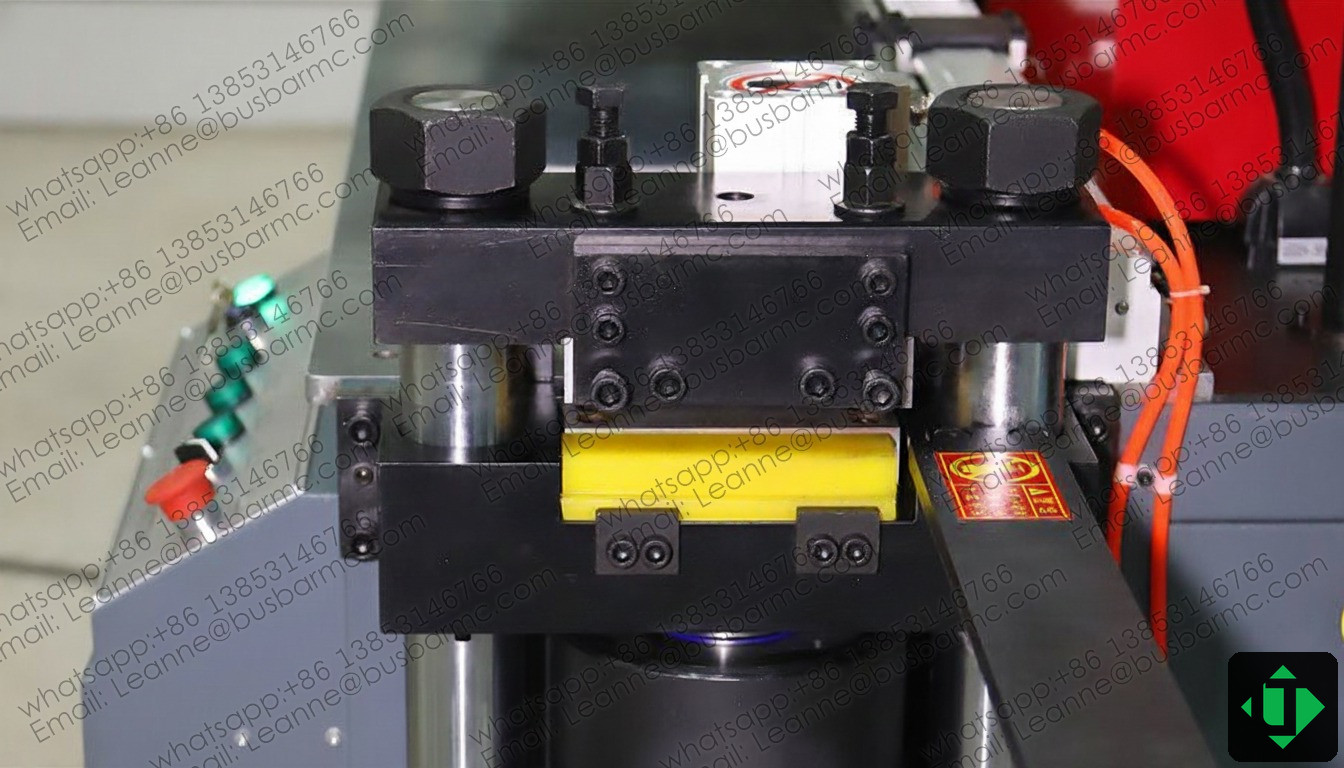
Cutting (shearing) unit close-up — inspect length, squareness, burr and hold-down marks
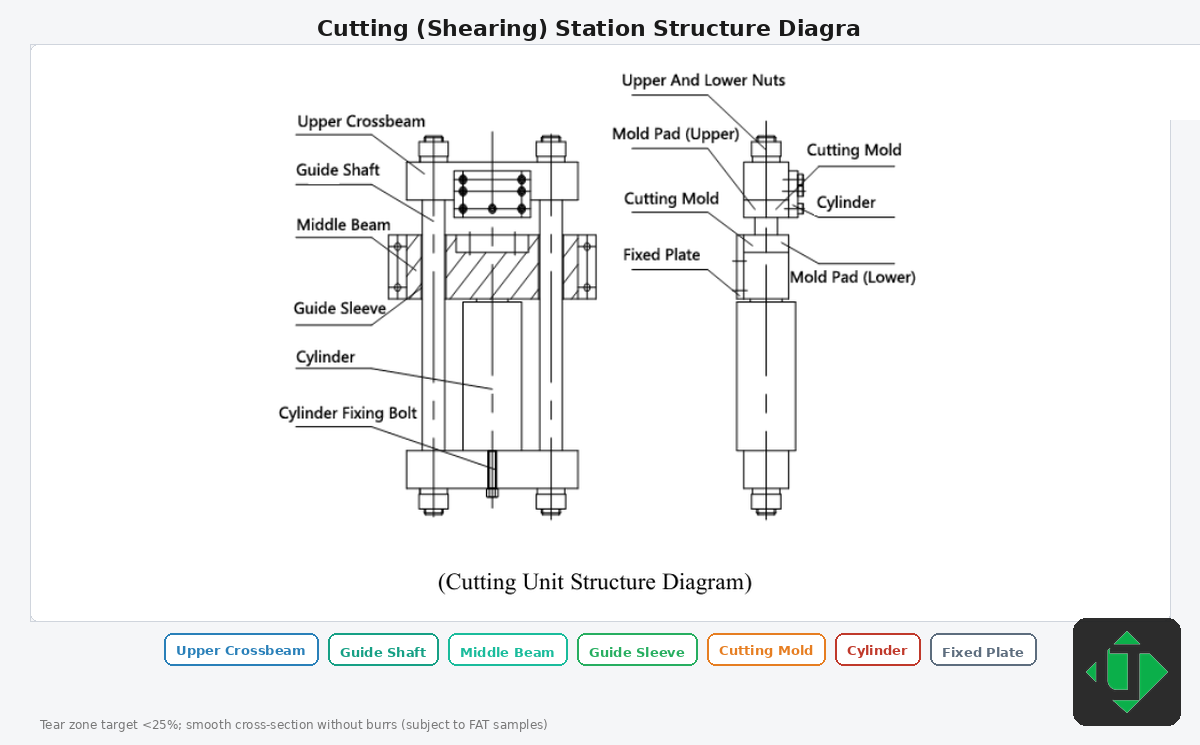
Cutting station structure diagram
What specifications to confirm before buying
Egyptian workshops cutting copper (often Cu-ETP / C11000) or aluminum for panels in Cairo, 10th of Ramadan or Alexandria should lock these items into the RFQ—not only a maximum thickness line in a catalogue.
| Specification | Why it matters |
|---|---|
| Material grade (Cu / Al / laminated) | Cutting load and blade choice |
| Temper | Burr, wear, force |
| Width × thickness | Capacity + clearance |
| Raw bar length | Table / roller support |
| Finished length tolerance | Manual stop vs servo / CNC |
| Burr limit | Blade quality + process capability |
| Squareness | Downstream bend / weld / fit |
| Surface / film | Hold-down marks |
| Cycle time | Automation level |
| Positioning method | Manual / servo / CNC |
| Blade spare lead time | Downtime risk |
Cutting methods vs positioning systems
Evaluate how the bar is separated separately from how length is positioned.
Shearing (hydraulic blade)
Common for copper and aluminum busbars in Egyptian panel shops: short cycle, limited chips. Edge quality depends on clearance, sharpness, alignment, clamp, and support. Wrong clearance produces burrs and local deformation that later show up at punch, bend, or assembly.
Saw cutting
Consider when the end profile or material condition makes shearing unsuitable. Expect chips, kerf loss, and often a longer cycle time. Compare blade life and secondary finishing—a saw is not automatically “higher quality.”
Manual stop vs servo / CNC positioning
| Positioning | Best fit | Watch-out |
|---|---|---|
| Manual stop / scale | Mixed low volume | Operator variation |
| Servo length stop | Recurring lengths | Travel + dead zone |
| CNC program recall | Multi-length kits | Revision control |
Finished-cut results to inspect
Agree before FAT: tolerance, instrument, sample quantity, measure points, inspector, and acceptance method. Inspect finished length, squareness, max burr height, end deformation, and surface damage. For continuous tests, record consecutive parts—not one selected sample—in the FAT pack. Length error on a riser or main bar will not “disappear” when the piece later has to fit an approved IEC 61439 cabinet.
Where cutting sits on a 3-in-1
On LTMC U-3-C machines the shear shares the frame with punch and bend, with independent pump groups so stations can run in parallel when staffed. That compact layout suits many mixed Egyptian panel cells better than a lonely shear, unless cutting hours are the true bottleneck.
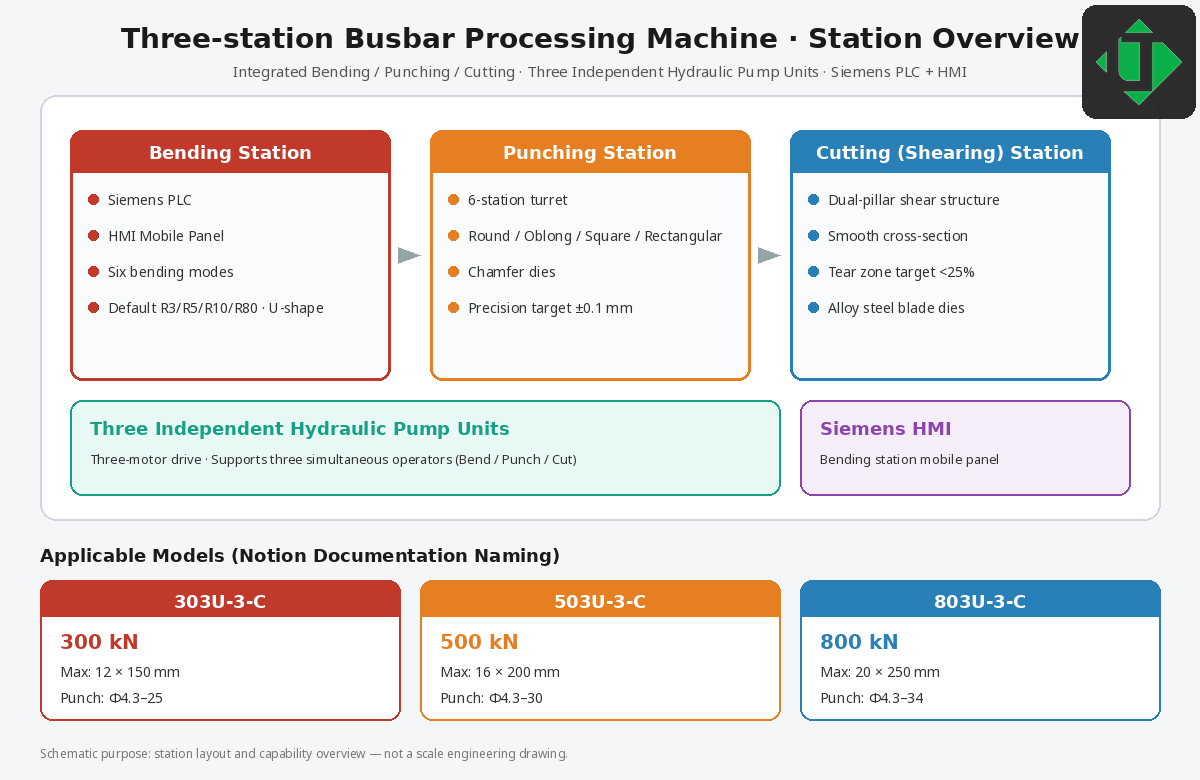
Three-station layout overview — the shear shares the frame with punch and bend
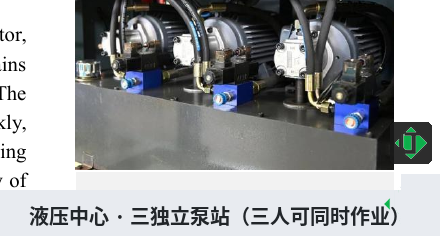
Hydraulic center: three independent pump units
Published shear envelopes track model class: about 12×150 (303) · 16×200 (503) · 20×250 (803) mm—confirm width wording on the OA.
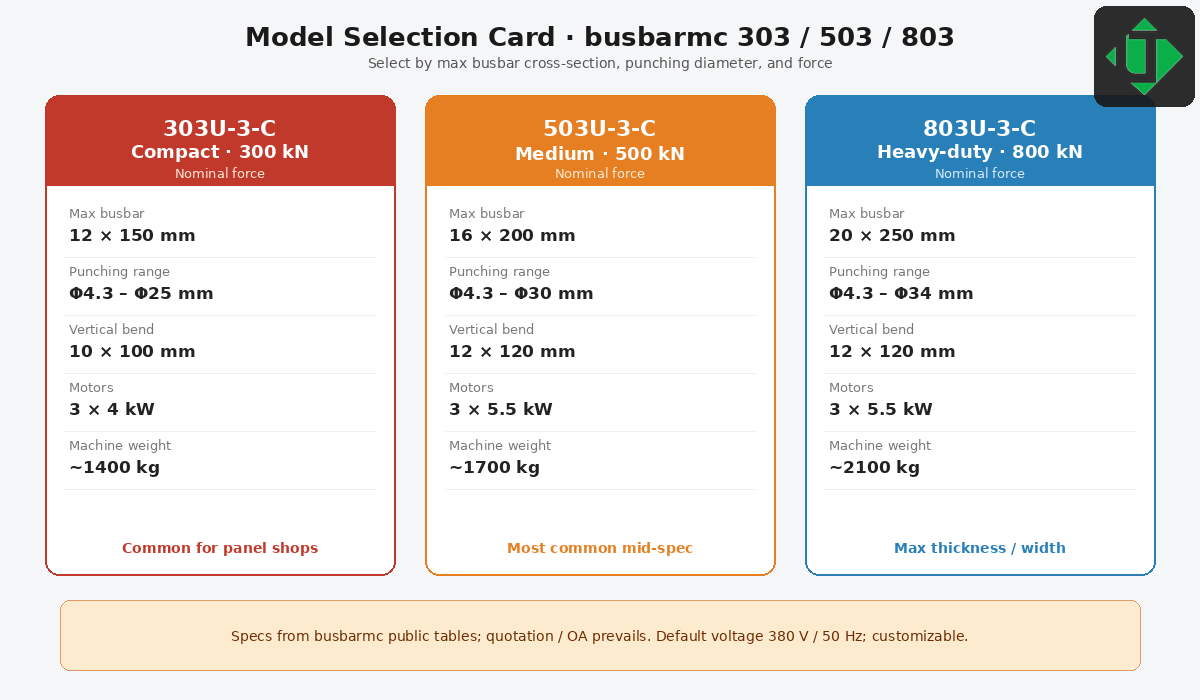
Model selection card: 303U-3-C / 503U-3-C / 803U-3-C
Buying tips (decision cues)
- Write acceptance numbers for length / square / burr before the RFQ.
- Ask for blade material, clearance guidance, and spare lead time—spares and remote support matter more than a single demo cut.
- Match positioning to how often lengths repeat in your Egyptian production mix.
- If most jobs also punch and bend, prefer a sized 3-in-1 over a lonely shear—unless cutting is the bottleneck.
- Require FAT with your representative section (copper or aluminum as used in the shop), not only brochure copper.
Product context: 3-in-1 busbar machine.
FAQ
What is a busbar cutting machine?
Equipment that shears or saws copper or aluminum busbars to drawing length with controlled edge quality.
Shear or saw?
Shear for most flat Cu/Al production in panel workshops; saw when the drawing or material rejects shearing. Compare cycle, kerf, chips, and finishing.
Can the shear on a 3-in-1 replace a dedicated cutter?
Often yes for mixed SME work typical of Egyptian panel builders. Choose dedicated cutting when cut hours per day justify a separate station or automatic feed line.
How do I judge cut quality?
Measure length, squareness, burr, deformation, and surface—on multiple consecutive parts under agreed instruments.
What LTMC models cover cutting?
303U-3-C / 503U-3-C / 803U-3-C include hydraulic shear stations sized to the envelopes above. Confirm on quotation and FAT.
Next step for Egyptian workshops
Share representative busbar drawings, copper or aluminum grade and temper (for example Cu-ETP / C11000 where specified), max width × thickness, and FAT sample requirements. LT / LTMC can support Egyptian panel and transformer shops with technical guidance, commissioning, operator training, spare parts, and remote support. Product pages and contact:
- 3-in-1 busbar machine
- CNC busbar bending machine
- CNC busbar punching and cutting machine
- egyptbusbar.com · Contact
Where a public page and the order acknowledgment differ, treat the OA and FAT samples as the source of truth.
Latest News
How a Busbar Bending Machine Works — Principles and Operation for Egyptian Workshops
How a busbar bending machine works in Egyptian workshops: principles, springback, flat vs edge bends, and official LT CNC operation steps 001–013 on 3-in-1 bend stations 303U-3-C /...
2026-11-13
Three-Station Busbar Machine Technical Guide for Egyptian Factories — LT 303/503/803
Technical guide to three-station (3-in-1) busbar machines for Egyptian factories: punch, cut and bend on LT 303U-3-C / 503U-3-C / 803U-3-C, with model cards, station diagrams, RFQ ...
2026-11-10
What Is a Busbar Machine? Cutting, Punching and Bending for Egyptian Switchgear
A busbar machine cuts, punches and bends copper or aluminum busbars for Egyptian switchgear. Learn how 3-in-1 stations work and how to choose LT 303U-3-C / 503U-3-C / 803U-3-C.
2026-11-10
Busbar Punching Guide for Egyptian Panel Shops — Hole Accuracy, Dies and Positioning
Busbar punching quality in Egyptian panel shops is finished hole position from the datum, size, burr and edge distance. Match turret dies and clearance on LTMC 303U-3-C / 503U-3-C ...
2026-11-10
How to Use a Busbar Bending Machine in Egyptian Switchgear Production
Production bending in Egyptian switchgear shops needs locked recipes, tooling and first/mid/last checks so released angles stay stable across shifts on LT 303U-3-C / 503U-3-C / 803...
2026-11-10
What Is a Busbar Bending Machine and How Does It Work in Egyptian Workshops?
A busbar bending machine forms copper or aluminum bars to drawing angles for Egyptian workshops. Judge released angle, radius and surface—not tonnage alone—on LTMC 3-in-1 bend stat...
2026-11-10
LTMC CNC Busbar Machine Egypt
Professional CNC Busbar Machine & Related Equipment Manufacturer.
Company Strength
Adequate Inventory
Fast Shipping
Our Products
CONTACT US
Address: No.9566 Jingshi Rd.Jinan City , Shandong , China


© COPYRIGHT 2025 LTMC CNC Busbar Machine Egypt

Contact Us
Our passion is to bring your ideas to life. Work with our design team to create a one-of-a-kind custom finish or cladding system to create a truly unique space. Together we can make your story stand out. If you need something to request a sample, request pricing, or request a demo, please fill out the contact form below. Explain your request in as much detail as you can and a representative will contact you within 1 business day.